



Industry News
Home / News / Industry News / How AC Capacitor Manufacturers Ensure Quality: Testing, Materials, Safety
How AC Capacitor Manufacturers Ensure Quality: Testing, Materials, Safety
Posted by Admin | 16 Sep
Content
- 1 Quality Is Decided at the Film and Winding Stage
- 2 100 Percent Electrical Testing Separates Factories from Assemblers
- 3 Encapsulation, Aging, and Traceability Decide Long-Term Survival
- 4 Standards and Safety Class Give You an Objective Shortcut
- 5 What a Buyer Should Verify Before Ordering
- 6 What to Expect from a Capacitor-Focused HVAC Parts Supplier
- 7 Frequently Asked Questions
A shipment of 450 VAC CBB65 run capacitors arrives with clean labels and tidy packaging. Six weeks into the cooling season, 6 percent of them come back with bulged aluminum shells and open overpressure disconnectors, and the warranty cost wipes out the distributor's margin. That failure pattern is rarely a single bad capacitor. It is a chain of decisions: film grade, winding tolerance, encapsulation quality, electrical screening depth, and standards compliance. This article explains how AC capacitor manufacturers ensure quality at every step, and what you can verify before placing an order.
Quality Is Decided at the Film and Winding Stage
A capacitor's final reliability is fixed at the film and winding stage, because no end-of-line test can repair a weak dielectric layer. AC run capacitors use metallized polypropylene film with a vacuum-deposited zinc-aluminum layer. Base film thickness and metallization consistency set the dielectric's quality: inconsistent deposition creates hot spots that age faster, while the unmetallized margin at each edge controls creepage and edge breakdown risk. Two capacitors with identical ratings from different factories can therefore have very different field life.
Key definition
Self-healing: when a micro-defect in the polypropylene film breaks down under voltage, the thin metal layer around the fault vaporizes and isolates the damage so the capacitor keeps operating. Weak metallization heals poorly, internal resistance rises, and thermal runaway follows.
Winding tension and film alignment decide capacitance accuracy. A disciplined manufacturer holds winding tension stable across every spindle, which keeps capacitance scatter close to plus or minus 5 percent at 50/60 Hz. Poor winding produces units that pass a single reading but drift as internal layers shift under thermal cycling.
A quality CBB65 run capacitor holds capacitance within plus or minus 5 percent at line frequency. Wider scatter points to uncontrolled film, metallization, or winding variance.
100 Percent Electrical Testing Separates Factories from Assemblers
Manufacturers that genuinely control quality screen every capacitor, not just batch samples, for the electrical parameters that predict field failure. In-line automatic testers measure capacitance against the rated microfarad value, dissipation factor, insulation resistance, and dielectric withstand on 100 percent of units leaving the line.
Dissipation factor, expressed as tan delta, deserves the most attention. At 100 Hz, good polypropylene film stays at or below 0.002. Values above that mean moisture ingress or film degradation, and the capacitor will run hot inside a cramped compressor compartment. The tan delta and voltage parameters of an AC capacitor explain this relationship in detail.
| Test | What it detects | Typical acceptance limit |
| Capacitance at 50/60 Hz | Winding and film thickness consistency | Rated microfarads, plus or minus 5 percent |
| Dissipation factor (tan delta) | Moisture, film degradation, metallization defects | 0.002 or lower at 100 Hz |
| Insulation resistance | Dielectric integrity and seal quality | 3,000 megohms or higher at 20°C |
| Dielectric withstand | Edge breakdown and internal voids | No failure at 1.5 times rated voltage for 60 seconds |
| Overpressure disconnector | End-of-life safety behavior | Opens before case rupture, per declared class |
Screening standard: quality manufacturers test 100 percent of production for capacitance, tan delta, and dielectric withstand, then validate long-term behavior with sample endurance runs at elevated voltage and case temperature.
Encapsulation, Aging, and Traceability Decide Long-Term Survival
Long-term survival is decided by encapsulation, aging, and batch traceability, not just by the readings on the test bench. Three process controls separate consistent capacitor manufacturers from resellers.
Encapsulation and sealing
In a dry or oil-filled aluminum shell, the seal is the border between the dielectric and ambient humidity. Moisture is the main enemy of metallized film: once water vapor enters, tan delta climbs and life collapses. Thermal class ratings, typically 70°C or 85°C maximum case temperature, define how much heat the design tolerates. High ambient heat is why CBB65 units for compressor circuits are often specified at the 85°C class rather than the 70°C class used for fan motors.
Aging and burn-in
Serious factories apply voltage at elevated temperature for a defined period before the final measurement. Burn-in accelerates infant mortality: weak film spots and bad internal connections fail inside the factory instead of inside a customer's condenser unit.
Batch traceability
Every date code should trace back to a film lot, a winding machine, and a test record. If a bad batch appears in the field, a traceable manufacturer can isolate the population and respond before the problem spreads. A reseller without batch records cannot do this, and that gap is a quality risk by itself.
±5%Capacitance tolerance at line frequency
60 sWithstand hold at 1.5 times rated voltage
85°CHigh-temperature CBB65 case class
Standards and Safety Class Give You an Objective Shortcut
Compliance with IEC 60252-1 and a declared safety class is the fastest objective filter for capacitor quality. IEC 60252-1 is the International Electrotechnical Commission standard for AC motor capacitors, and it covers capacitance tolerance, endurance, climate categories, and fail-safe behavior. CE marking and UL recognition follow the same logic in different markets.
The safety class P0, P1, or P2 describes end-of-life behavior. P2 units integrate an overpressure disconnector that opens the internal circuit before the case bursts, which is why P2 is the accepted choice for CBB65 run capacitors on compressor circuits. The certification evidence matters more than the printed logo: request the report number and confirm it covers the exact voltage and microfarad rating you plan to buy. Manufacturers publish IEC 60252-1 verification requirements for CBB65 capacitors, and the same verification logic applies across the rest of the range.
If a supplier cannot produce a test report for IEC 60252-1 and a declared safety class, treat the datasheet as a marketing document.
Check the temperature class on the label as well. A unit rated for 85°C maximum case temperature will survive the same location where a 70°C unit ages quickly, even at identical voltage.
What a Buyer Should Verify Before Ordering
A simple incoming inspection, combined with three targeted supplier questions, exposes most quality gaps in minutes. Independent of the factory's claims, build your routine around measurable checks.
- Request the latest IEC 60252-1 test certificate and confirm the report covers the exact voltage and microfarad rating you are buying.
- Measure capacitance and tan delta on incoming samples with an LCR meter at the rated frequency.
- Verify the label states thermal class, rated voltage, tolerance, and safety class, and that the print survives handling.
- Inspect the aluminum shell for bulges, dents, leaking sealant, and terminals that can be rotated by hand.
- Ask for batch traceability and a written field failure-rate policy, including how returns are credited.
- Prefer a supplier with stable stock across multiple capacitor families; model-to-model depth usually tracks process maturity.
Case temperature is the largest controllable life factor. Our guide to thermal management of AC capacitor failures shows how mounting position and airflow change failure rates in real installations.
Relative service life vs. case temperature
Estimated life multiplier for an 85°C-rated CBB65: each 10°C reduction in case temperature roughly doubles service life.
Sample at least five units from different cartons of one batch, measure capacitance, tan delta, and withstand, and compare the spread between samples. Consistent spread is a stronger quality signal than one perfect reading.
What to Expect from a Capacitor-Focused HVAC Parts Supplier
A supplier whose catalog, ratings, and verification data line up across capacitor families lets you standardize replacements instead of chasing single models. For distributors, repair chains, and e-commerce sellers, quality management includes supply stability as much as electrical results.
Ningguo Kingcool Import and Export Co., Ltd, operating as Kingcool, covers the capacitor families that dominate the aftermarket: CBB60 and CBB61 motor running capacitors for pumps and fan motors, CBB65R1, CBB65R2, and CBB65R3 run capacitors for compressor circuits, CD60 starting capacitors, and CH85 units for microwave ovens. Sourcing these families through one channel gives you consistent quality-check requirements, one traceability pathway, and simpler warranty handling.
Three product families cover most replacement demand: CBB65R1 run capacitors in 370 VAC, 440 VAC, and 450 VAC ratings for compressor applications, CBB60 motor running capacitors for water pumps and blowers, and CD60 motor starting capacitors for single-phase startup. Each family sits inside the same verification discipline described above.
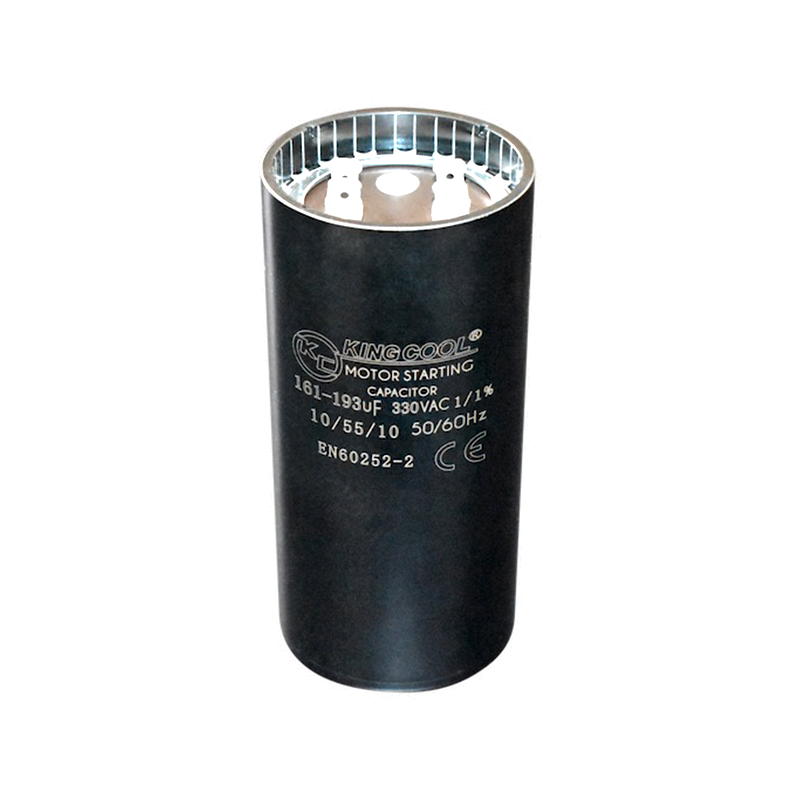 Wholesale KINGCOOL CD60 Motor Starting Capacitor Manufacturers, Company, ExporteWe Wholesale CD60 Motor Starting Capacitor, Ningguo KINGCOOL Is China CD60 Motor Starting Capacitor, Manufacturers, Company And Exporters...View Product →
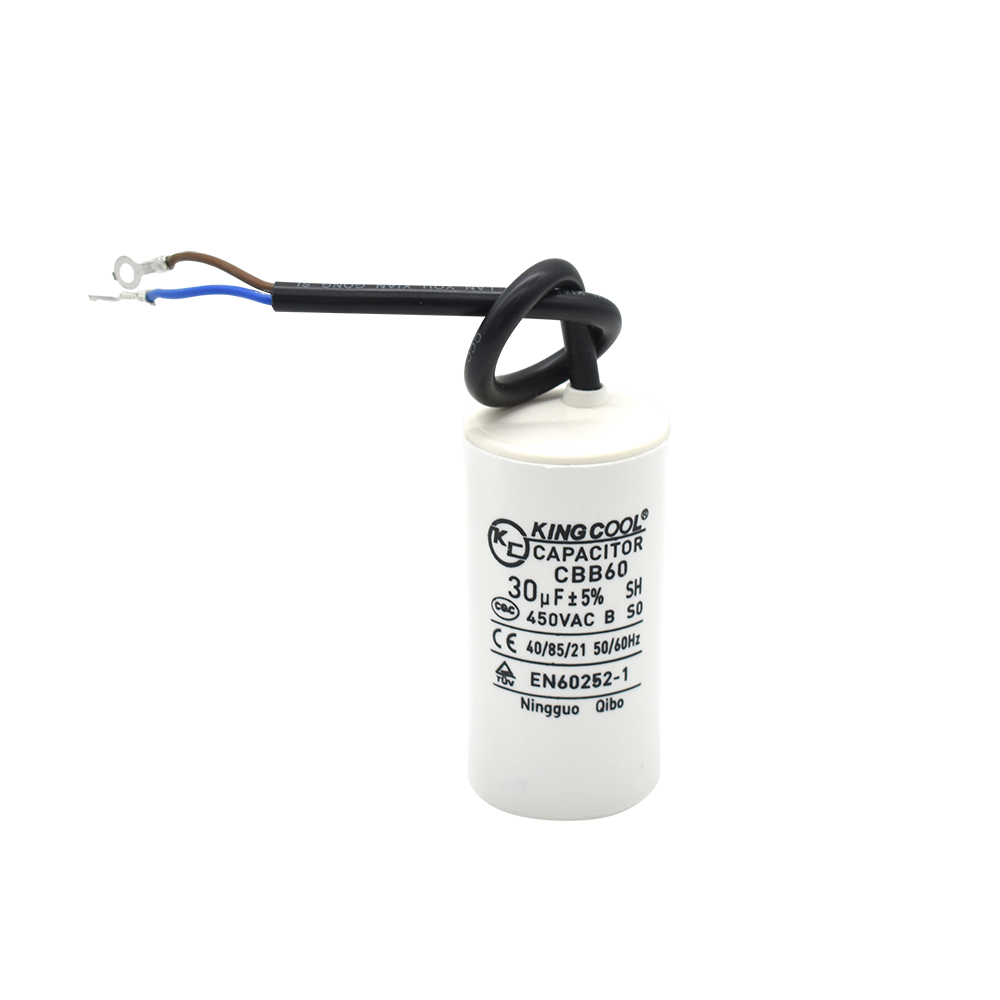 Wholesale KINGCOOL CBB60 motor running capacitor Manufacturers, Company, ExporteWe Wholesale CBB60 motor running capacitor, Ningguo KINGCOOL Is China CBB60 motor running capacitor, Manufacturers, Company And Exporters...View Product →
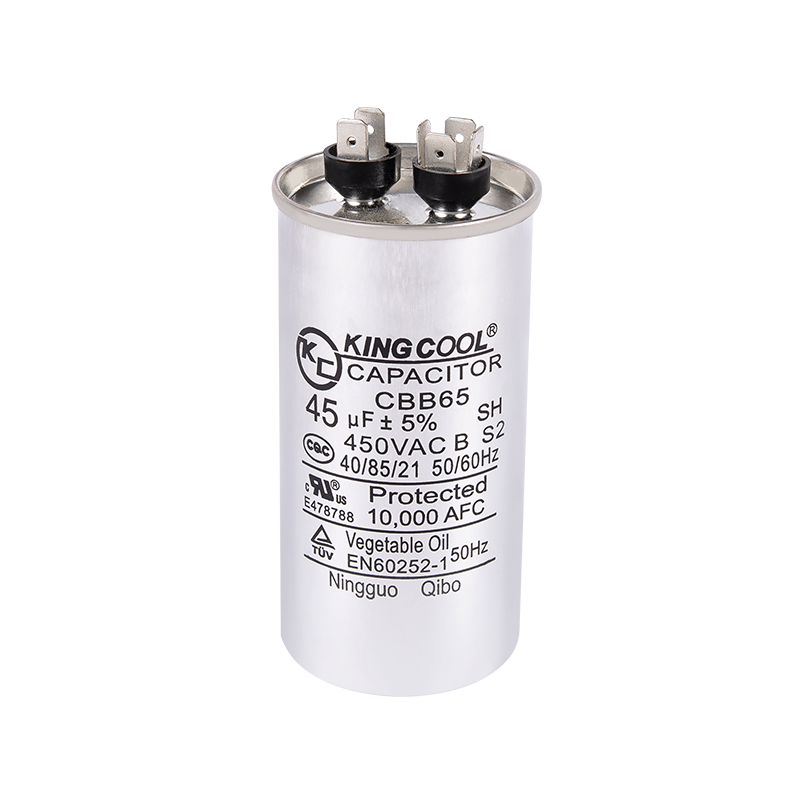 Wholesale KINGCOOL CBB65-R1 Manufacturers, Company, ExportersWe Wholesale CBB65-R1, Ningguo KINGCOOL Is China CBB65-R1, Manufacturers, Company And Exporters, details: Product Features: Metal case, p...View Product →
The practical rule: quality in AC capacitors is visible in three places: the measured electrical parameters, the declared safety and temperature class, and the traceability a supplier can demonstrate for every batch.
Frequently Asked Questions
What is the most important quality parameter in an AC run capacitor?
Capacitance accuracy at line frequency and dissipation factor. If capacitance drifts beyond plus or minus 5 percent, or tan delta rises above 0.002, motor current increases, winding temperature climbs, and compressor starting torque shifts out of specification.
What does safety class P2 mean on a CBB65 capacitor?
P2 means the unit includes an overpressure disconnector: at end of life, internal pressure breaks the connection before the case can rupture. For compressor circuits, P2 is the accepted standard because a bursting capacitor can damage nearby wiring and refrigerant lines.
How can I check whether a manufacturer really tests every unit?
Ask for the production test procedure and the factory's defect-ratio reports. Quality manufacturers screen 100 percent of units for capacitance, tan delta, and withstand voltage on automated lines, then run sample endurance tests at 1.25 times rated voltage. If the supplier cannot describe the test chain, treat the claim as unverified.
Why does case temperature affect capacitor life more than voltage?
Electrochemical aging in metallized film accelerates with heat. For an 85°C-rated capacitor, service life roughly doubles for every 10°C below the rated case temperature and drops sharply above it. Keeping the capacitor away from compressor heat and maintaining condenser airflow extends life more than choosing a higher voltage class alone.
Bottom line: capacitor quality is measurable, standards-backed, and traceable. Evaluate the film and winding controls, verify the electrical test data, and buy from suppliers who can document each batch.
Recommended NEWS:
How to Choose the Right Capacitor Model for Your AC Unit Replacement
AC Capacitor: Essential Guide for Replacement and Testing
How to choose the right AC Motor type according to the specific needs of the air conditioning system?
AC Capacitor: Essential Guide to Sizing, Symptoms, and Types
AC Capacitor: From Basics to Applications, A Comprehensive Guide
AC Capacitor vs. Compressor Capacitor: Functions and Applications

Efficient charging, stable output, capacitor, thefirst choice for electric drive.
- Address: North of Funing Rd., Helixi Economic and Technology Development Zone, Ningguo, Anhui, China
- Phone/WhatsApp: +86-18110862602
- Email: [email protected]
Subscribe Our Newsletter
If you have anything to consult, you canfollow us, we will contact you as soon aspossible

Copyright © Ningguo Kingcool Import and Export Co., Ltd All Rights Reserved. Custom HVAC Parts & Accessories Suppliers