

 EN
 English
 Français
 Español
 عربى



Industry News
Home / News / Industry News / Thermostats & Temperature Controllers: Better HVAC Temperature Management
Thermostats & Temperature Controllers: Better HVAC Temperature Management
Posted by Admin | 07 Oct
Content
- 1 What a Thermostat Actually Does Inside an HVAC System
- 2 Thermostats vs. Temperature Controllers: Two Approaches to the Same Loop
- 3 Measurable Improvements in Comfort, Energy, and Equipment Life
- 4 Selecting a Temperature Controller That Matches the System
- 5 Installation Errors That Undermine Control Performance
- 6 Frequently Asked Questions
A split air conditioner in a small office was short-cycling every four minutes. Room temperature swung between 21 and 26 degrees Celsius, and the energy bill climbed month after month. The refrigerant charge was correct and the capacitor tested fine; the real fault was in the control loop. The mechanical thermostat's wide differential made the room overshoot in both directions. Swapping it for a digital controller with a one-degree differential cut cycling by roughly 60 percent and held the room at a steady 23 degrees. That is what temperature management does for an HVAC system.
What a Thermostat Actually Does Inside an HVAC System
Thermostats and temperature controllers form the decision-making layer of every air conditioning and refrigeration system. They sense air temperature, compare it against a setpoint, and switch the compressor or heating circuit on or off. Every comfort and efficiency result in the building depends on how well that loop is executed.
Differential, also called hysteresis, is the temperature gap between the point where a controller switches the load off and the point where it switches it back on. A wide differential produces fewer but longer cycles and larger temperature swings. A narrow differential holds temperature steady but increases the number of compressor starts.
When that differential is too wide, several problems appear at once:
- Room temperature drifts beyond the comfort band because the system runs too long and rests too long.
- Compressor short-cycling increases contactor wear, stresses the start capacitor, and raises winding temperature.
- Repeated startup current draws more energy than steady-state running, so the utility bill climbs.
- Uneven temperatures trigger occupant complaints and false service calls.
Thermostats vs. Temperature Controllers: Two Approaches to the Same Loop
The practical difference is precision and adjustability. A mechanical thermostat relies on a bimetallic strip whose calibration drifts over years of service and whose differential is fixed at the factory. An electronic temperature controller uses a thermistor sensor, displays the measured temperature, and lets the technician set the differential and switching mode. A microcomputer controller adds programmable scheduling and tighter tolerance for refrigeration duty.
Mechanical Thermostat
- Fixed differential around 2 to 4 degrees C
- No display, no adjustment
- Calibration drifts with age
- Suits refrigerators and window units
Digital Temperature Controller
- Adjustable differential from 0.5 degrees C
- Digital display and setpoint dial
- Sensor-based, stable over years
- Suits split AC, heat pumps, cold rooms
| Type | Sensor | Differential | Adjustable | Typical application |
| Bimetal thermostat | Bimetallic strip | 2 to 4 degrees C | No | Refrigerators, window AC |
| Electronic thermostat | Thermistor | 0.5 to 1.5 degrees C | Yes | Split AC, heat pumps |
| Microcomputer controller | Thermistor or PT100 | 0.1 to 1 degree C | Yes, programmable | Cold rooms, display cases |
For room air conditioners, the STN-601 HVAC system controller replaces a failing original thermostat with an adjustable differential, a large temperature display, and a relay output rated for the compressor contactor coil. It is a direct example of the upgrade path described above.
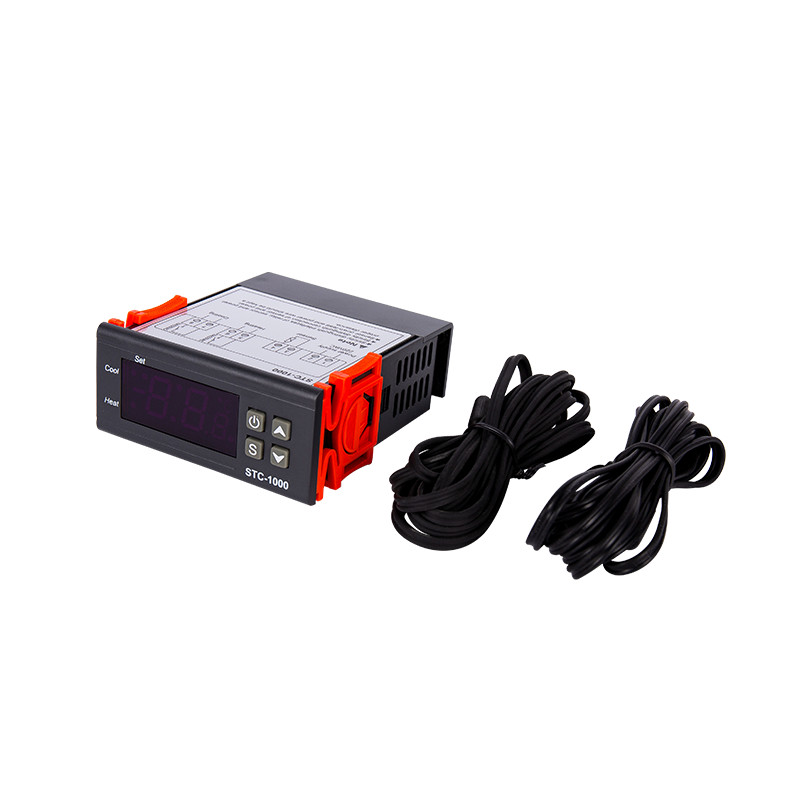 STN-601 HVAC Controller for Room Air ConditionersThis controller replaces a failing thermostat with an adjustable differential and relay output, directly enabling the temperature stability, energy savings, and longer compressor life discussed here.View Product →
Measurable Improvements in Comfort, Energy, and Equipment Life
Upgrading control precision produces three measurable outcomes: smaller temperature swings, lower energy use, and longer compressor life. Contractors see all three in the same retrofit.
60% fewer compressor starts
+/-0.5 C temperature stability
3% energy saved per degree
A room with manual cycling swings about 4 degrees C around the setpoint. A mechanical thermostat narrows that to roughly 2 degrees C. A digital controller with a 1-degree differential holds the space within 0.5 degrees C. That range is the difference between a room that feels comfortable and one that alternates between stuffy and chilly.
Temperature swing around setpoint, degrees C
Manual cycling
4
Mechanical thermostat
2
Digital controller
0.5
Energy demand follows the same curve. The commonly cited industry figure is about 3 percent of cooling energy saved for every 1 degree C the setpoint is raised; preventing overshoot achieves similar savings by avoiding over-cooling in the first place. Compressor starts also matter for durability. More than eight starts per hour is short-cycling, because every start draws locked-rotor current that heats the motor windings. A controller with a sensible differential keeps starts in the three-to-four-per-hour range on a typical split system.
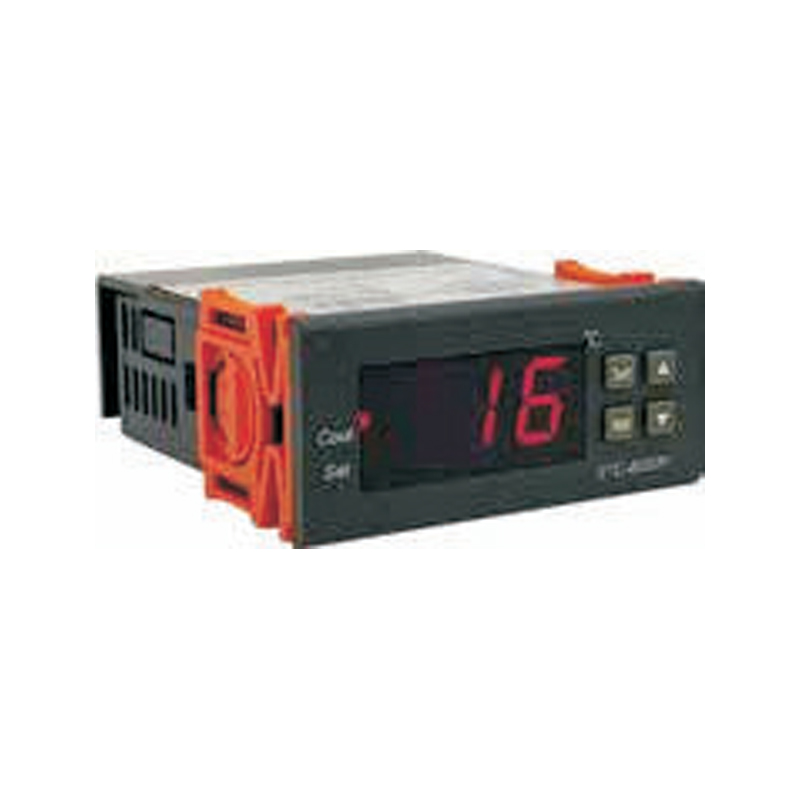 ETC-512B Digital Temperature ControllerA refrigeration-only controller with adjustable off-cycle defrost and heating option, its differential settings help prevent short-cycling and match the compressor start guidance described in the text.View Product →
Selecting a Temperature Controller That Matches the System
Selecting a temperature controller is a matching exercise, not a brand preference. Five specifications determine whether the part works in a given system.
- Supply voltage and frequency. A 220-240V, 50Hz controller cannot run on a 110V, 60Hz circuit without a transformer or a different model.
- Sensor type and range. Most room applications use a 10k thermistor; refrigeration may need a wider range that includes defrost termination.
- Differential adjustment. Look for an adjustable differential between roughly 0.5 and 3 degrees C.
- Output relay rating. Check the relay contact current against the connected load. A contactor coil draws far less than a fan motor but has an inductive inrush.
- Control mode. Heating, cooling, or automatic changeover changes wiring and setpoint logic.
The most common mismatch in replacement work is a controller rated for a resistive load being used on an inductive load. Always verify the relay rating in amps against the actual coil or motor current.
For a deeper walkthrough of voltage, sensor, and wiring compatibility across common room and split units, see the complete guide to air conditioner temperature controllers.
Installation Errors That Undermine Control Performance
Even a correctly matched controller fails when installation mistakes make the sensor read the wrong temperature or the relay switch the wrong load. Field experience points to four recurring errors.
- Mount the sensor in the return air path. Direct sunlight, internal heat sources, and cold drafts all skew the reading. The sensor should sample the air the room actually returns to the unit.
- Wire the relay in series with the contactor coil. Match line and neutral according to the supplied diagram. Reversing them leaves the controller powered but unable to switch the load.
- Set the differential to about 1 degree C for comfort applications. Leave 2 degrees C or wider in cold storage, where frequent starts hurt compressor life more than a slightly wider temperature band.
- Configure a compressor delay of at least 3 minutes. Where the controller supports a delay, it protects the compressor against rapid restarts after power dips.
Universal A/C control systems go a step further by replacing the original control board on many split and window units. The wiring diagram must be matched to the indoor fan, outdoor fan, and compressor relay layout of the specific unit. This makes them a practical option for older units whose original boards are no longer available.
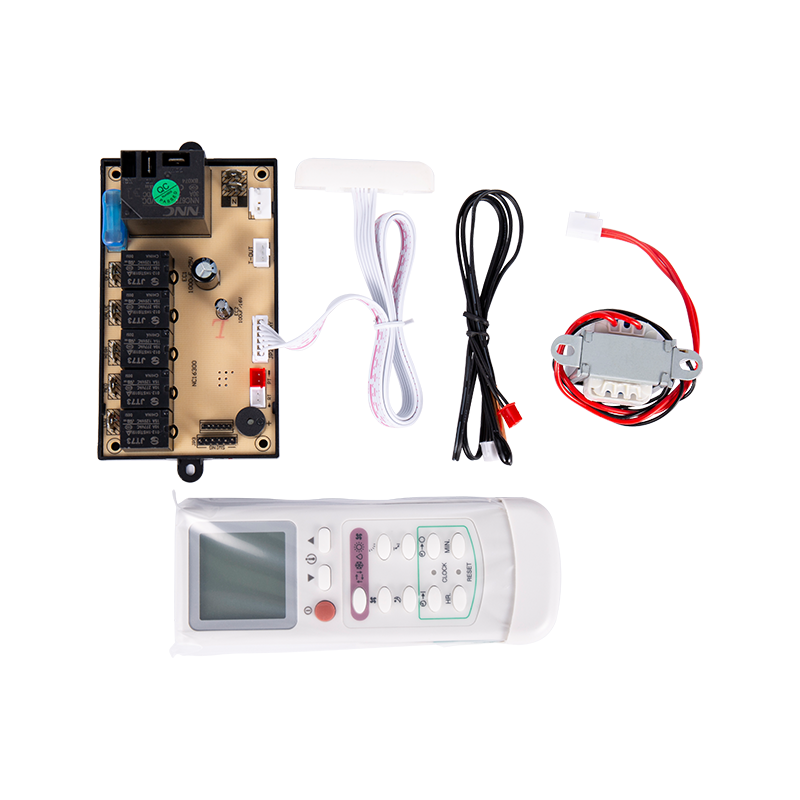 Universal A/C Control System BoardThis universal board replaces original control boards on split and window units, offering multiple fan speeds and modes—useful when original boards are unavailable, as noted in the preceding paragraph.View Product →
Frequently Asked Questions
What is the ideal differential for a room air conditioner?
For comfort cooling, a differential of about 1 degree C balances stable temperature with a reasonable number of compressor starts. A tighter 0.5 degree C works in a bedroom but increases cycling. Use 2 to 3 degrees C in refrigeration applications where compressor longevity matters more than a narrow temperature band.
Can a universal temperature controller replace the original thermostat board in a split air conditioner?
Yes, if the supply voltage, sensor type, and relay ratings match. Universal controllers typically cover common 110V and 220V units. Verify the indoor fan speed wiring before connecting, because reversing fan taps can damage the motor.
How many compressor starts per hour are acceptable?
Three to eight starts per hour is normal for a cycling system. More than eight indicates short-cycling, which raises winding temperature, accelerates capacitor wear, and inflates energy use. A properly set differential and a minimum off-delay return the system to the normal range.
Do temperature controllers handle both cooling and heating?
Most electronic and microcomputer controllers include a heat/cool mode selector. In a system with both a compressor and a heating element, the controller activates the correct load based on the selected mode and the sensor reading.
If you need help matching a thermostat, temperature controller, or universal control system to a specific air conditioning or refrigeration unit, contact the parts specialists at Ningguo Kingcool Import and Export Co., Ltd. with the unit model and the current control board details.
Recommended NEWS:
Why Choose an Aluminum Shell CBB65 Capacitor 250VAC 50/60Hz for High-Temperature HVAC Systems?
How Does Ambient Temperature Affect the Service Life of an Oil-Filled CBB65 Run Capacitor in HVAC Systems?
Air-Conditioner Temperature Controller: Complete Guide
HVAC Capacitor Cost in 2024: What to Expect When Replacing Yours
Is an AC Capacitor CBB65B Suitable for High-Temperature Environments in Air Conditioning Units?
How HVAC Motors Support Reliable Air Conditioner and Refrigeration System Operation




Efficient charging, stable output, capacitor, thefirst choice for electric drive.
- Address: North of Funing Rd., Helixi Economic and Technology Development Zone, Ningguo, Anhui, China
- Phone/WhatsApp: +86-18110862602
- Email: [email protected]
Subscribe Our Newsletter
If you have anything to consult, you canfollow us, we will contact you as soon aspossible

Copyright © Ningguo Kingcool Import and Export Co., Ltd All Rights Reserved. Custom HVAC Parts & Accessories Suppliers