



Industry News
Home / News / Industry News / Run Capacitor vs Start Capacitor: What Is the Difference? HVAC Buying Guide
Run Capacitor vs Start Capacitor: What Is the Difference? HVAC Buying Guide
Posted by Admin | 03 Sep
Content
- 1 The Short Answer: Different Jobs, Different Duty Cycles
- 2 Start Capacitor: A Short but Powerful Kick
- 3 Run Capacitor: The Steady Workhorse
- 4 Start Capacitor vs Run Capacitor: Side-by-Side Comparison
- 5 Why You Should Never Substitute One for the Other
- 6 How to Choose the Right Capacitor
- 7 Reliability and Procurement Considerations
A refrigeration compressor hums loudly but never rotates into full speed. The technician opens the electrical panel and sees two cylindrical components sitting side by side. One is slightly bulged at the seam, and its terminals show a faint burn mark. The correct replacement depends entirely on one question: was that a start capacitor or a run capacitor? Although they share the same circuit, they perform different jobs, operate on different duty cycles, and fail in different patterns. Choosing the wrong type turns a ten-minute repair into a return visit and an unhappy customer. This guide explains the difference between the two, how to identify each one, and what to verify before adding replacements to your parts inventory.
The Short Answer: Different Jobs, Different Duty Cycles
A start capacitor supplies a brief, high-energy boost to get the motor rotating, then leaves the circuit. A run capacitor stays energized the whole time the motor operates, continuously improving torque and efficiency. This distinction matters well beyond the schematic. A start capacitor cannot handle continuous current and will overheat within minutes if it stays engaged. A run capacitor cannot supply the locked-rotor torque needed to break the motor free from standstill, so the motor hums and trips the overload instead of starting. Every diagnosis, repair decision, and stocking decision starts from these two roles.
Start Capacitor: A Short but Powerful Kick
How a Start Capacitor Works
A start capacitor connects in series with the motor's start winding and stays in the circuit for only the first one to three seconds. During that brief window, it delivers a high capacitance value, commonly from 70 microfarads up to several hundred microfarads, to create the phase shift that produces high starting torque. Once the motor reaches roughly 75 percent of rated speed, a centrifugal switch, potential relay, or electronic relay cuts it out of the circuit. Inside the case, the dielectric is electrolytic rather than metallized film, which is why these parts are designed for short bursts of high current, not long-term current flow.
Physical Signs and Failure Symptoms
Start capacitors usually come in dark plastic cases and are frequently labeled with the CD60 designation. A failing unit often shows a swollen seam or a cracked housing, while the motor itself may hum loudly or draw excessive current without turning. In compressor circuits, a failed start capacitor is a leading cause of repeated overload protector trips. Some start capacitors include a bleed resistor across the terminals; when replacing one, keep the same wiring arrangement to avoid relay chatter and false readings. Stocking CD60 motor starting capacitors in the common 70 to 120 microfarad range covers most residential and light commercial compressor service calls.
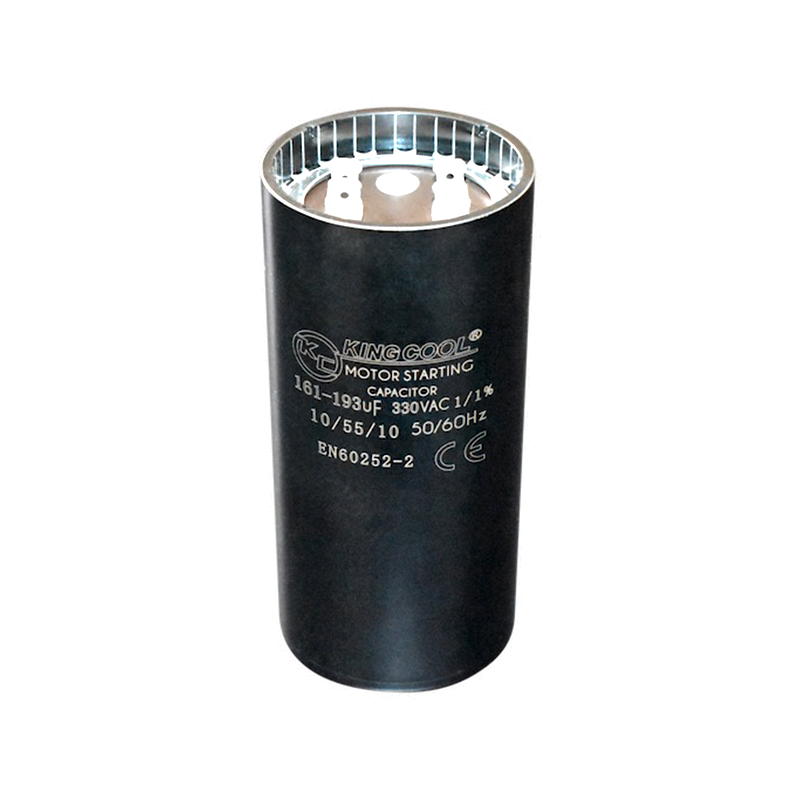 Wholesale KINGCOOL CD60 Motor Starting Capacitor Manufacturers, Company, ExporteWe Wholesale CD60 Motor Starting Capacitor, Ningguo KINGCOOL Is China CD60 Motor Starting Capacitor, Manufacturers, Company And Exporters...View Product →
Run Capacitor: The Steady Workhorse
How a Run Capacitor Works
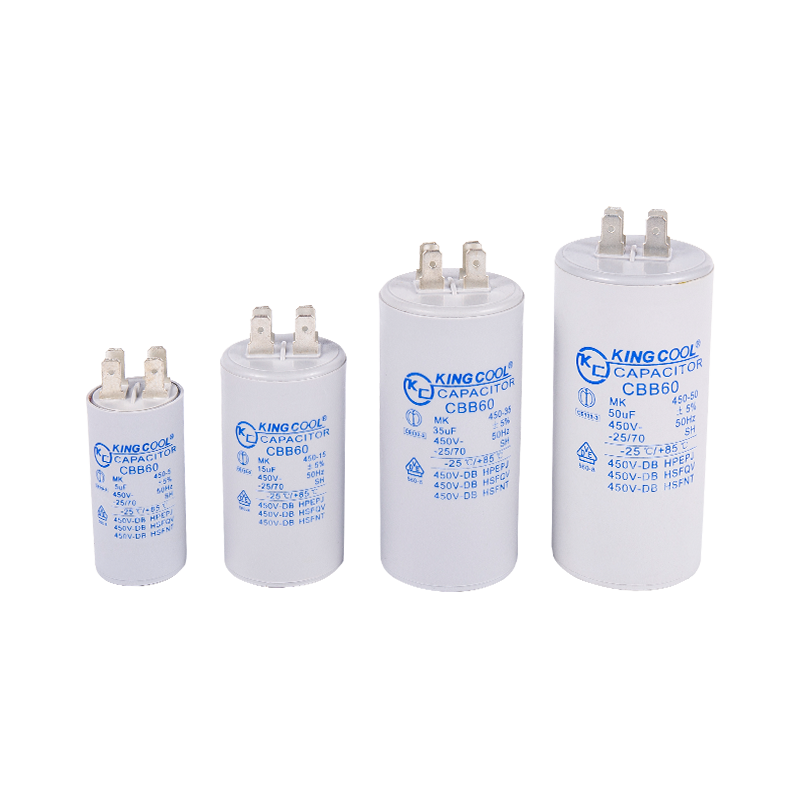
Unlike the start capacitor, a run capacitor remains in the circuit for as long as the motor operates. It is filled with oil and uses a metallized film dielectric, which gives it a much longer thermal life than an electrolytic part. Typical capacitance values for HVAC applications range from 3 microfarads on small fan motors to 70 microfarads on larger compressor motors. By staying energized, the run capacitor maintains a continuous phase shift between the start and run windings. That phase shift keeps running torque higher, amperage draw lower, and winding temperatures cooler. These are the familiar CBB60 motor running capacitors found in metal cases on outdoor condensing units and in window air conditioners.
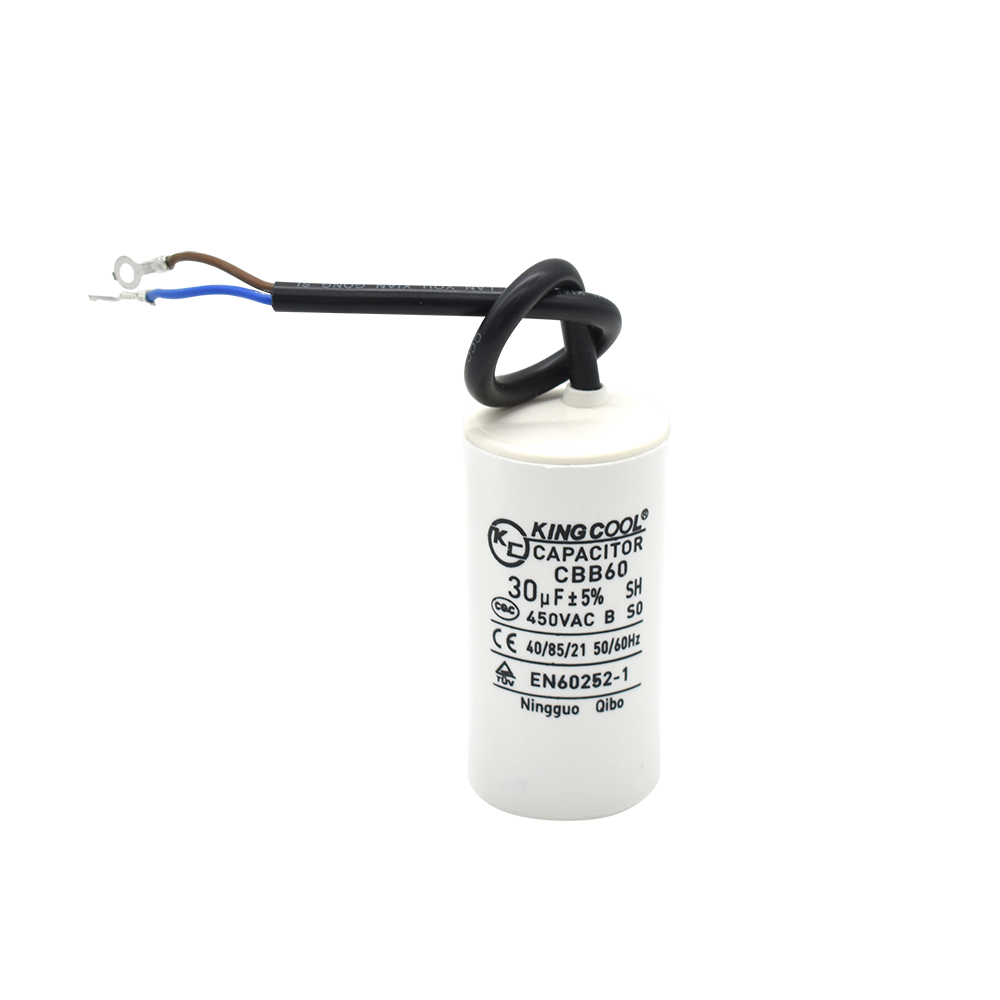 Wholesale KINGCOOL CBB60 motor running capacitor Manufacturers, Company, ExporteWe Wholesale CBB60 motor running capacitor, Ningguo KINGCOOL Is China CBB60 motor running capacitor, Manufacturers, Company And Exporters...View Product →
Failure Modes That Shorten Equipment Life
When a run capacitor loses capacitance, the motor usually still starts, but it runs hotter, consumes more power, and delivers less cooling. Over time, the extra heat degrades winding insulation and shortens compressor life. Because this failure is less dramatic than a dead start capacitor, technicians often misdiagnose it as a weakening motor. Measuring the microfarad value with a multimeter and comparing it with the nameplate rating catches the problem early. Our guide to AC capacitor replacement and testing covers the measuring procedure, safety discharge steps, and common mistakes to avoid.
Start Capacitor vs Run Capacitor: Side-by-Side Comparison
The table below summarizes the differences that matter most in the field and at the ordering desk.
| Parameter | Start Capacitor | Run Capacitor |
|---|---|---|
| Primary role | Starting torque boost | Continuous phase correction |
| Duty cycle | 1-3 seconds per start | Entire motor running time |
| Capacitance range | 70 µF and higher | 3-70 µF typical |
| Dielectric type | Electrolytic | Oil-filled film |
| Typical case | Plastic, dark color | Metal cylinder or oval |
| Common series | CD60 | CBB60, CBB61, CBB65 |
| Typical failure sign | Motor hums, will not start | Motor runs hot, high amp draw |
Why You Should Never Substitute One for the Other
Never put a start capacitor in a run capacitor position, and never expect a run capacitor to start a motor. Leaving a start capacitor engaged for more than a few seconds causes internal overheating, electrolyte venting, and eventually a bulged or shorted case that can damage the relay. Using a run capacitor in place of a start capacitor simply does not deliver enough torque; the motor stalls, the overload trips, and the compressor may short-cycle until protective components give out. In both scenarios, the motor does not run as designed, and valuable equipment can be harmed within minutes.
The replacement rules are just as strict. Match the microfarad value as closely as the nameplate specifies; a difference of 5 to 10 percent is usually acceptable, but installing a start capacitor where a run capacitor belongs is a mistake, not an adjustment. Always use the same or a higher voltage rating, never lower. A 370VAC replacement is appropriate for a 370VAC or lower-rated circuit, and a 440VAC unit offers additional headroom in regions with unstable line voltage.
How to Choose the Right Capacitor
Check the Nameplate and the Markings
Every motor or compressor lists the required capacitance and voltage on its nameplate. The same information appears on the capacitor body: microfarad value, AC voltage rating, temperature rating, and terminal arrangement. Run capacitors for air conditioning and refrigeration use the CBB60, CBB61, or CBB65 series designations, while start capacitors commonly use CD60. Confirm that the replacement has the same number of terminals: two for a straight run capacitor, three for a dual capacitor that serves both the compressor and the condenser fan.
Consider the Application
For a compressor that operates thousands of hours per year, a dual run capacitor simplifies replacement and reduces the number of spare parts a technician needs to carry. Dual capacitors combine compressor and fan capacitor functions in one metal case and are widely used in split-system air conditioners. For distributors, carrying a structured range of CBB65R1 run capacitor models alongside CD60 start capacitors covers most replacement scenarios without duplicating every microfarad value. Environment also matters: capacitors rated for 70 degrees Celsius survive rooftop condenser conditions far better than basic 50-degree-rated parts.
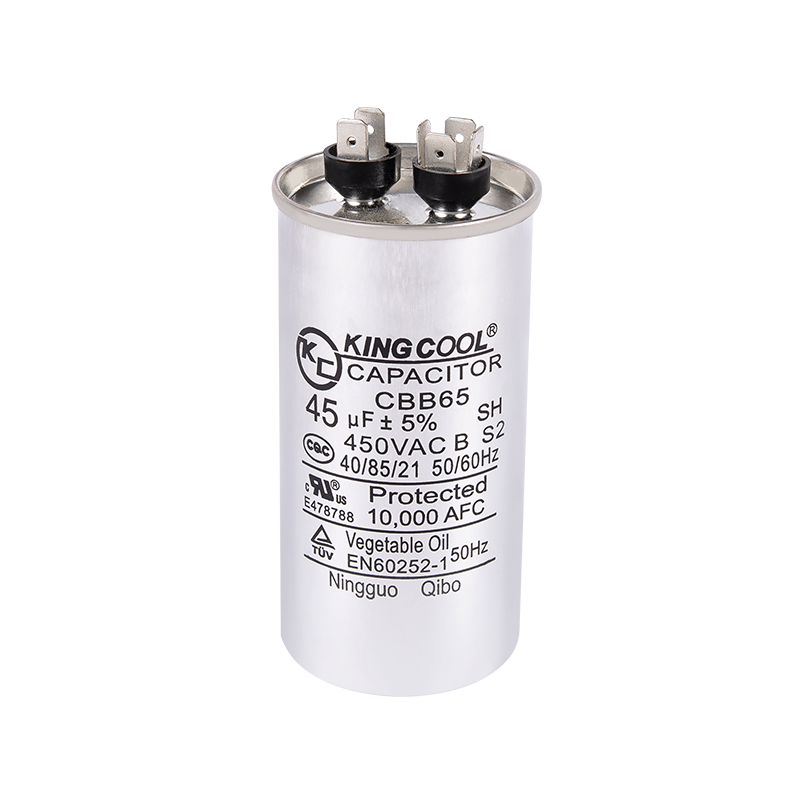 Wholesale KINGCOOL CBB65-R1 Manufacturers, Company, ExportersWe Wholesale CBB65-R1, Ningguo KINGCOOL Is China CBB65-R1, Manufacturers, Company And Exporters, details: Product Features: Metal case, p...View Product →
Verify the Failure Before Ordering
Because both capacitor types can fail in the same circuit, identify the failure pattern first: does the motor hum without rotating, pointing to a start capacitor, or does it run hot with high amperage, pointing to a run capacitor? The common causes of compressor capacitor failure extend beyond component age to include high ambient temperatures, poor ventilation, voltage spikes, and repeated short cycling. Understanding the cause prevents a replacement that fails again two weeks later.
Reliability and Procurement Considerations
Not every capacitor with the same printed label performs the same way. In practice, the difference between a part that lasts one cooling season and one that lasts many is internal quality: dielectric material, thermal sealing, terminal construction, and manufacturing consistency. For professional buyers, several safeguards matter:
- Select the type that matches the duty cycle: CD60 for starting, CBB60 or CBB65 for running.
- Use the correct voltage class and do not down-rate from the original specification.
- Source from a supplier that can provide the full capacitor range with model data for cross-referencing.
- Request replacement guidance for failure analysis rather than guessing from the label alone.
HVAC distributors and repair companies often consolidate both capacitor categories with one supplier to simplify inventory planning and reduce the risk of mismatched components. Kingcool supplies the complete capacitor range for air conditioning, refrigeration, and appliance applications, complemented by practical industry guidance on capacitor failure symptoms and testing procedures. Carrying both start and run capacitors in a logical range of microfarad values keeps service teams ready for the next humming compressor before the first diagnosis is made.
Recommended NEWS:
HVAC Capacitor Cost in 2024: What to Expect When Replacing Yours
What are the key factors in the selection criteria of AC Capacitor in different application scenarios?
Capacitor: The "energy buffer master" of electronic devices, how does it quietly change your life?
AC Capacitor Types: Choosing the Right One for Your HVAC System
Optimizing Motor Performance: A Guide to CD60 Starting Capacitors
Understanding AC Capacitors: A Comprehensive Guide


Efficient charging, stable output, capacitor, thefirst choice for electric drive.
- Address: North of Funing Rd., Helixi Economic and Technology Development Zone, Ningguo, Anhui, China
- Phone/WhatsApp: +86-18110862602
- Email: [email protected]
Subscribe Our Newsletter
If you have anything to consult, you canfollow us, we will contact you as soon aspossible

Copyright © Ningguo Kingcool Import and Export Co., Ltd All Rights Reserved. Custom HVAC Parts & Accessories Suppliers