

 EN
 English
 Français
 Español
 عربى



Industry News
Home / News / Industry News / Electrolytic vs Film Capacitor for AC Applications: Which Should You Choose?
Electrolytic vs Film Capacitor for AC Applications: Which Should You Choose?
Posted by Admin | 28 Oct
Content
The Short Answer: Film for Running, Electrolytic for Starting
On a hot July afternoon, a split air conditioner can go from cooling normally to a stalled compressor in a few seconds. The compressor hums, draws high current, and trips the thermal overload. A technician finds a bulged run capacitor and a start capacitor that reads zero capacitance. The order sheet asks for the same replacements, but the available components look different. This is where the electrolytic-capacitor versus film-capacitor decision becomes an everyday buying problem, not just an electronics lesson.
For AC capacitors, the short rule is simple: use film capacitors for continuous run duty and reserve electrolytic capacitors for brief start events. That rule determines construction, rating, safety class, and shelf life, and it should guide every replacement you specify.
How Electrolytic and Film Capacitors Differ in AC Circuits
The two families are built for different jobs. Understanding their construction and failure behavior explains why mixing them up causes premature motor failures.
Construction and Dielectric
Film capacitors use a thin polypropylene film as the dielectric, with a vacuum-deposited metal layer acting as the electrode. When an overvoltage creates a weak point, the metal around that point evaporates and the capacitor recovers its insulation. That self-healing behavior is why metalized film capacitors such as the CBB60 and CBB65 series can survive minor electrical abuse in motor circuits.
Bipolar electrolytic capacitors, on the other hand, use an aluminum foil with an oxide layer and a wet electrolyte. The construction gives high capacitance per volume, which is why start capacitors can be several hundred microfarads in a compact can. But the electrolyte can dry out over time, and the capacitor does not heal itself the same way as a film type.
Electrical Behavior and Losses
The AC power frequency in most applications is 50 or 60 Hz, far below the ripple frequencies where electrolytic capacitors normally operate. Film capacitors have very low dielectric loss and a low dissipation factor, so they stay cool under continuous 50/60 Hz current. Electrolytic capacitors have higher equivalent series resistance and dissipation factor, so they generate more heat when current flows through them.
For a start capacitor, that heat is acceptable because the current lasts only a fraction of a second. For a run capacitor, the current lasts the entire run cycle, so the heat must be low. That single factor explains why you rarely see an electrolytic capacitor used as a permanent part of a fan or compressor circuit.
Failure Modes That Change the Risk Profile
Film capacitors typically fail as a gradual loss of capacitance, an open circuit, or a bulged can at the end of service life. The self-healing effect gives some warning before the motor finally stops. Electrolytic capacitors fail by drying out, swelling, leaking, or venting. Because they store more energy per volume, a shorted bipolar electrolytic start capacitor can be more dramatic and can stress the motor start winding as well.
| Feature | Film Capacitor (CBB60/CBB65) | Bipolar Electrolytic (CD60) |
|---|---|---|
| Dielectric | Polypropylene film | Aluminum oxide with wet electrolyte |
| Polarity | Non-polarized | Bipolar for AC starting duty |
| Typical role | Motor run, permanent connection | Motor start, temporarily switched |
| Capacitance range | Roughly 1-100 microfarad in HVAC sizes | Roughly 50-800 microfarad |
| Voltage range | 250 VAC to 450 VAC common | 125 VAC to 330 VAC common |
| Continuous current | Designed for hours of AC operation | Only seconds or tens of starts per hour |
| Dissipation factor | Low | Higher |
| Failure mode | Loss of capacitance, bulge, open | Electrolyte dry-out, swelling, venting |
| Self-healing | Yes | No or limited |
Where Each Type Belongs in an AC System
Single-phase motors rely on capacitors to create a rotating magnetic field from a single supply. The difference is how long that capacitor stays in the circuit.
Run Capacitors: The Case for Film
Run capacitors remain connected in series with the auxiliary winding for the entire operating time. Common examples are the CBB60 used for water pumps and the CBB65 used for air conditioner compressors. They must supply current continuously without overheating, which makes film construction the practical choice. A CBB60 motor running capacitor is rated for many thousands of hours under rated conditions, while an electrolytic of the same capacitance would overheat within minutes.
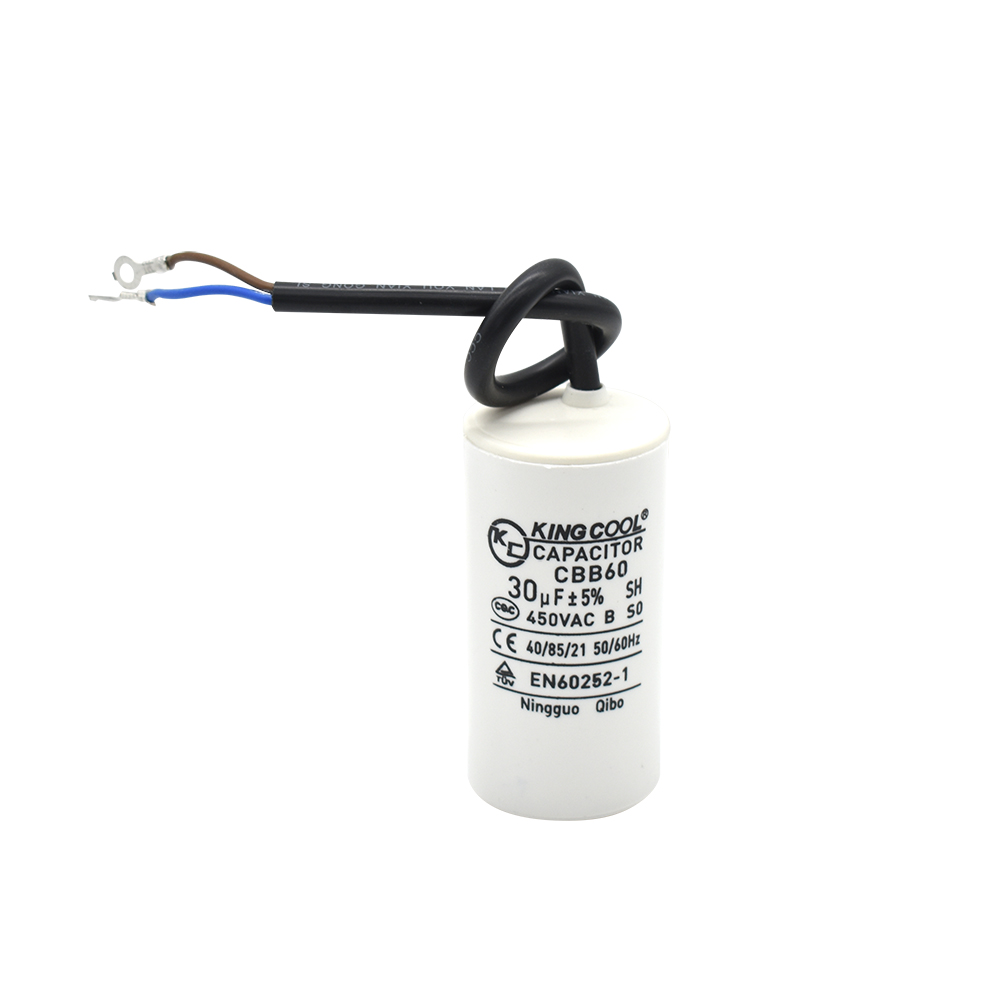 Wholesale KINGCOOL CBB60 motor running capacitor Manufacturers, Company, ExporteWe Wholesale CBB60 motor running capacitor, Ningguo KINGCOOL Is China CBB60 motor running capacitor, Manufacturers, Company And Exporters...View Product →
Replacing a failed run capacitor with a film type is almost always the correct move, provided the microfarad value and voltage rating match the original. If the original part was already a CBB series capacitor, staying with the same film technology prevents a repeat failure caused by the wrong switch in technology.
Start Capacitors: Why Electrolytic Versions Survive the Brief High-Current Job
Start capacitors are connected through a relay, centrifugal switch, or electronic controller and are disconnected as soon as the motor approaches running speed. The task is to create a phase shift with high capacitance for a short jolt. That is why CD60 starting capacitors appear in compressors and motors that need extra starting torque. The bipolar electrolytic construction gives a compact way to deliver that energy.
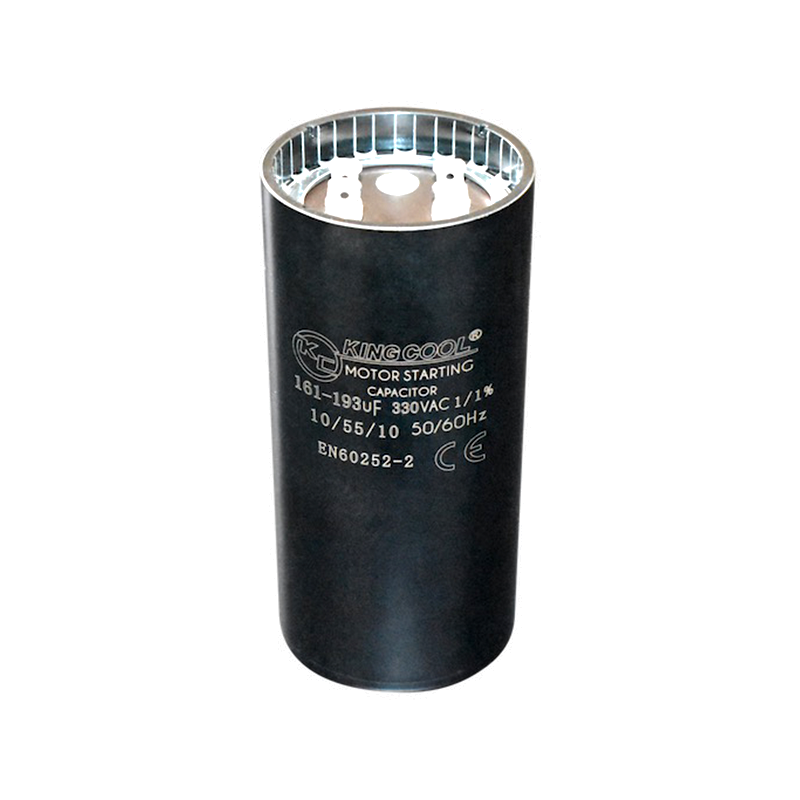 Wholesale KINGCOOL CD60 Motor Starting Capacitor Manufacturers, Company, ExporteWe Wholesale CD60 Motor Starting Capacitor, Ningguo KINGCOOL Is China CD60 Motor Starting Capacitor, Manufacturers, Company And Exporters...View Product →
If you replace a CD60 start capacitor with a film capacitor of the same microfarad value, the motor may not start reliably, or the capacitor package will be impractically large. Conversely, using an electrolytic as a run capacitor creates continuous heating that quickly shortens its life. The key is to respect the motor design.
Matching Voltage and Microfarad Without Guesswork
Do not choose a capacitor by system voltage alone. An air conditioner designed for 230 VAC can still use a CBB65 run capacitor labeled 450 VAC because the motor circuit imposes voltages that can exceed line voltage. Similarly, a start capacitor may be labeled 165 VAC or 250 VAC depending on the motor design. Read the original label, match the microfarad value, and keep the voltage rating at least equal to the original.
In practice, stay within the original capacitance tolerance and never increase the value by more than 10 percent for a run capacitor. Over-capacitance raises winding current and motor temperature. When you work on split AC systems, the difference between a 450 VAC and a 370 VAC run capacitor is more than a label, as explained in our 450 VAC versus 370 VAC safety overview.
What to Check Before You Order Capacitors
Label, Tolerance, and Safety Class
When you buy replacement capacitors for maintenance or resale, the label is your first source of truth. Confirm the rated capacitance in microfarads, the AC voltage rating, the temperature range, and the terminal style. For film capacitors, look for a proof that the unit meets IEC 60252-1 with a safety class such as P0, P1, or P2 and an S0 or S1 fault-disconnect classification. For start capacitors, check the permitted duty cycle in starts per hour.
The selection logic also depends on the motor type and load. Our earlier guide to choosing the right AC capacitor walks through common single-phase motor scenarios in the same language a service technician would use.
Sourcing and Storage Considerations
A bulged run capacitor may be a sign of high ambient temperature or repeated voltage transients, not just age. Replacing it with a compatible high-temperature-rated aluminum-shell unit can reduce callbacks. When you source from a supplier, ask about the film thickness, sealing method, and warehouse storage conditions, because moisture and heat can damage both film and electrolytic components before they reach the job site.
For a balanced spare-parts stock, carry film capacitors for running duty and bipolar electrolytic capacitors for starting duty. Keeping CBB60, CBB61, and CBB65 film capacitors, plus CD60 start capacitors, covers the majority of single-phase motor repairs. If you serve a large number of air conditioner compressor callouts, consider adding CBB65R1 aluminum-shell run capacitors to cover high-temperature and high-voltage replacements with extra margin.
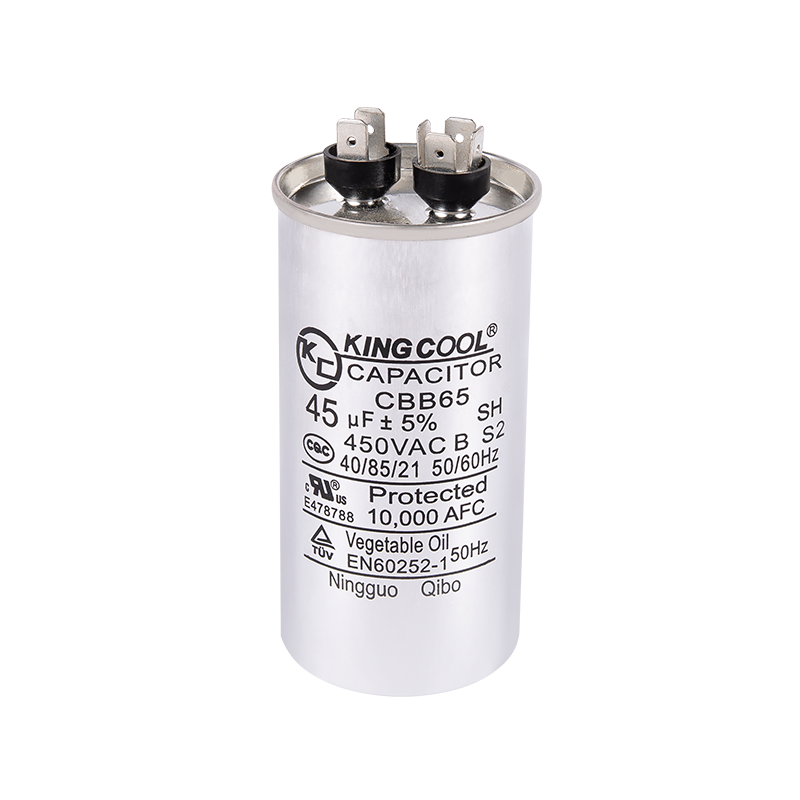 Wholesale KINGCOOL CBB65-R1 Manufacturers, Company, ExportersWe Wholesale CBB65-R1, Ningguo KINGCOOL Is China CBB65-R1, Manufacturers, Company And Exporters, details: Product Features: Metal case, p...View Product →
A Division of Labor, Not a Competition
The choice between electrolytic and film capacitors is not about which technology is better. It is about where each one belongs. Film wins where heat and continuous current matter. Bipolar electrolytic wins where an intense short pulse must be delivered from a compact body. Understanding that boundary lets you order the correct part the first time, avoid premature motor failures, and keep your customers cool when the outside temperature is climbing.
Recommended NEWS:
AC Capacitor Maintenance: Tips for Extending the Life of Your Cooling System
AC Capacitor Types: Choosing the Right One for Your HVAC System
How to Choose the Right Capacitor Model for Your AC Unit Replacement
AC Capacitor vs. Compressor Capacitor: Functions and Applications
AC Capacitor: From Basics to Applications, A Comprehensive Guide
CBB65-R1: Key Features and Applications of High-Performance AC Capacitors

Efficient charging, stable output, capacitor, thefirst choice for electric drive.
- Address: North of Funing Rd., Helixi Economic and Technology Development Zone, Ningguo, Anhui, China
- Phone/WhatsApp: +86-18110862602
- Email: [email protected]
Subscribe Our Newsletter
If you have anything to consult, you canfollow us, we will contact you as soon aspossible

Copyright © Ningguo Kingcool Import and Export Co., Ltd All Rights Reserved. Custom HVAC Parts & Accessories Suppliers