

 EN
 English
 Français
 Español
 عربى



Industry News
Home / News / Industry News / CBB65 vs CBB60 Motor Run Capacitors: Construction, Applications and Performance
CBB65 vs CBB60 Motor Run Capacitors: Construction, Applications and Performance
Posted by Admin | 04 Nov
Content
- 1 CBB65 vs CBB60: The Split Is Housing and Heat Path, Not Capacitance
- 2 Construction Comparison: Case, Filler, Terminals and Safety Class
- 3 Applications: Which Motor Each Type Belongs On
- 4 Performance: Heat, Voltage Stress and Realistic Service Life
- 5 Substitution Rules: When a CBB60 Can Stand In for a CBB65
- 6 Sourcing Checklist for Distributors and Repair Chains
- 7 Practical Answers on Fitting and Buying
A service technician pulls a failed 35 uF run capacitor from an outdoor condensing unit, finds a CBB60 of the same capacitance in the van, fits it, and the compressor starts. Six weeks later the replacement is open circuit too. The capacitance was never the problem; the case, the filler and the heat path were.
CBB60 and CBB65 look interchangeable on a specification line and behave very differently inside a compressor compartment. One is a general-purpose motor run capacitor in a plastic can sealed with epoxy resin, the other is a compressor-grade run capacitor in an aluminium can filled with refined castor oil or wax. The electrical job is identical, the thermal and mechanical design is not.
CBB65 vs CBB60: The Split Is Housing and Heat Path, Not Capacitance
Both parts are AC motor run capacitors built on metallized polypropylene film and both are normally qualified to IEC 60252-1, the standard for AC motor capacitors; the difference is that CBB60 houses the element in an epoxy-sealed plastic can for general motor duty, while CBB65 houses it in an aluminium can filled with refined castor oil or wax for compressor duty.
Core definition
A motor run capacitor is a metallized polypropylene film capacitor connected in series with the auxiliary winding of a single-phase motor. It stays in circuit continuously while the motor runs, shifting current phase to create a rotating field. CBB60 and CBB65 both belong to that family; what separates them is how the film element is housed, cooled and protected at end of life.
250 / 370 / 450 VAC Typical rated voltages across standard CBB60 and CBB65 series
5% Common capacitance tolerance band at 20 C for run capacitors
70 C / 85 C Usual maximum ambient classes offered in compressor-grade series
A CBB60 in a compressor terminal box usually starts the machine without complaint. Failure arrives weeks later, after repeated heating and cooling has pushed the film past the temperature the plastic housing can shed. A 35 uF, 450 VAC CBB60 and a 35 uF, 450 VAC CBB65 both start the same compressor on a bench test; they do not deliver the same number of summers.
Construction Comparison: Case, Filler, Terminals and Safety Class
Four construction details separate the two types: case material, filler, end-of-life protection and terminal geometry, and all four belong on the datasheet before any order is placed.
| Attribute | CBB60 | CBB65 |
| Dielectric | Metallized polypropylene film | Metallized polypropylene film |
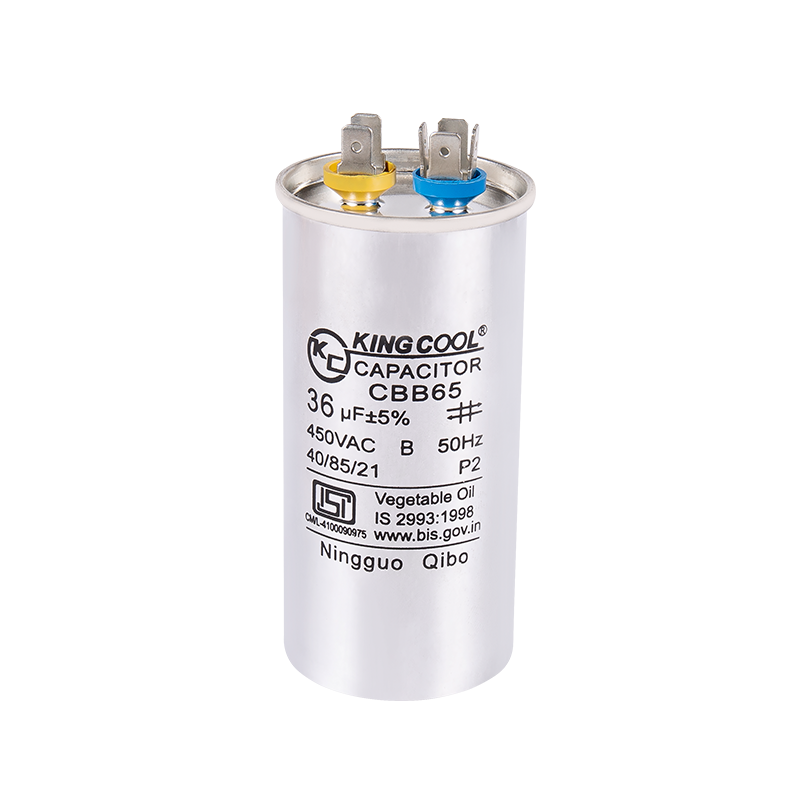
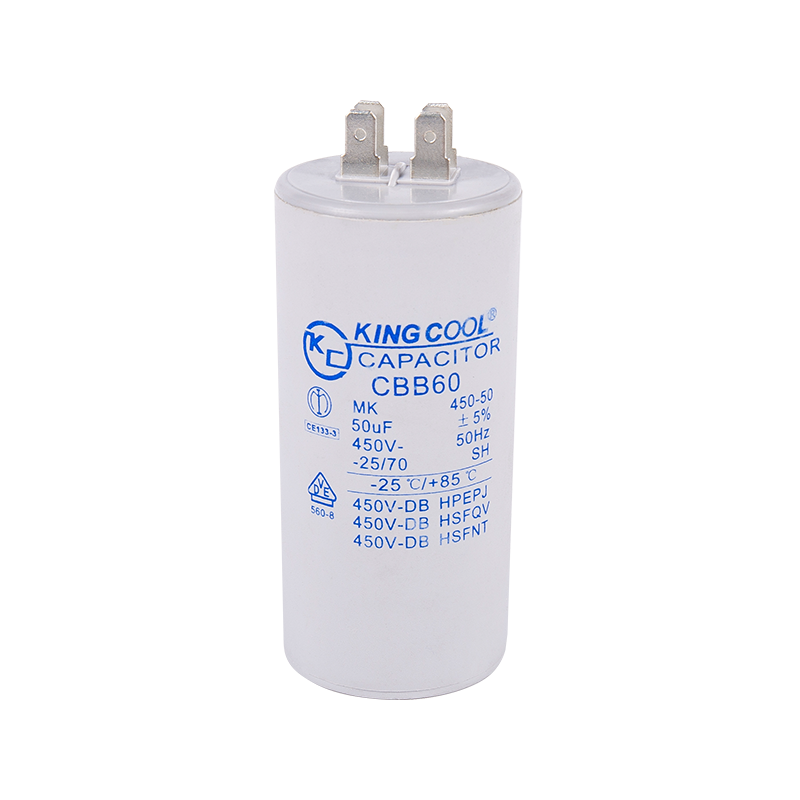
| Case material | Flame-retardant plastic can | Aluminium can, round or oval |
| Filler and seal | Epoxy resin, rigid potting | Refined castor oil or wax |
| End-of-life protection | Typically P0 or P1, no pressure interrupter in most series | Commonly P1 or P2 with an overpressure disconnector |
| Typical rated voltage | 250 / 400 / 450 VAC | 250 / 370 / 450 VAC |
| Typical capacitance range | 1 to 100 uF | 3 to 120 uF |
| Mounting | Plastic strap or bracket | Metal strap, stud or clamp |
| Designed thermal environment | Open, ventilated enclosures | Compressor compartments and condensing units |
Figures reflect typical standard series and should be confirmed against the manufacturer drawing for each rating.
The filler row deserves the most attention. Epoxy gives a rigid sealed block that holds the element and keeps moisture out, but it conducts heat poorly. Castor oil or wax wets the whole element, carries heat to the aluminium wall and lets the can work as a heat sink.
The safety-class row decides how the part fails. A P2 aluminium can carries a pressure interrupter, so rising internal pressure lifts the can top and opens the circuit. A plastic CBB60 usually has no such device, which means degradation appears as capacitance drift, a hot case, or a short circuit that trips the compressor overload.
Applications: Which Motor Each Type Belongs On
CBB60 belongs on open, ventilated single-phase motors and CBB65 belongs inside sealed compressor compartments where ambient temperature stays high; matching the capacitor to the enclosure matters more than matching it to the connector.
CBB60 on pumps, laundry equipment and general single-phase motors
The plastic-case series covers moderate ambient conditions with continuous or intermittent duty, which describes most single-phase motor loads outside refrigeration.
- Water pumps and booster sets, where a 450 VAC CBB60 is the standard fit on 0.75 to 2.2 kW single-phase motors
- Washing machine and dryer drum motors, commonly 250 to 400 VAC in the 8 to 20 uF range
- Ventilation fans, air-handling blowers and evaporative cooler motors
- Small hermetic compressors in dehumidifiers, water coolers and display cabinets
- Gate, shutter and workshop machine motors running from a 230 VAC supply
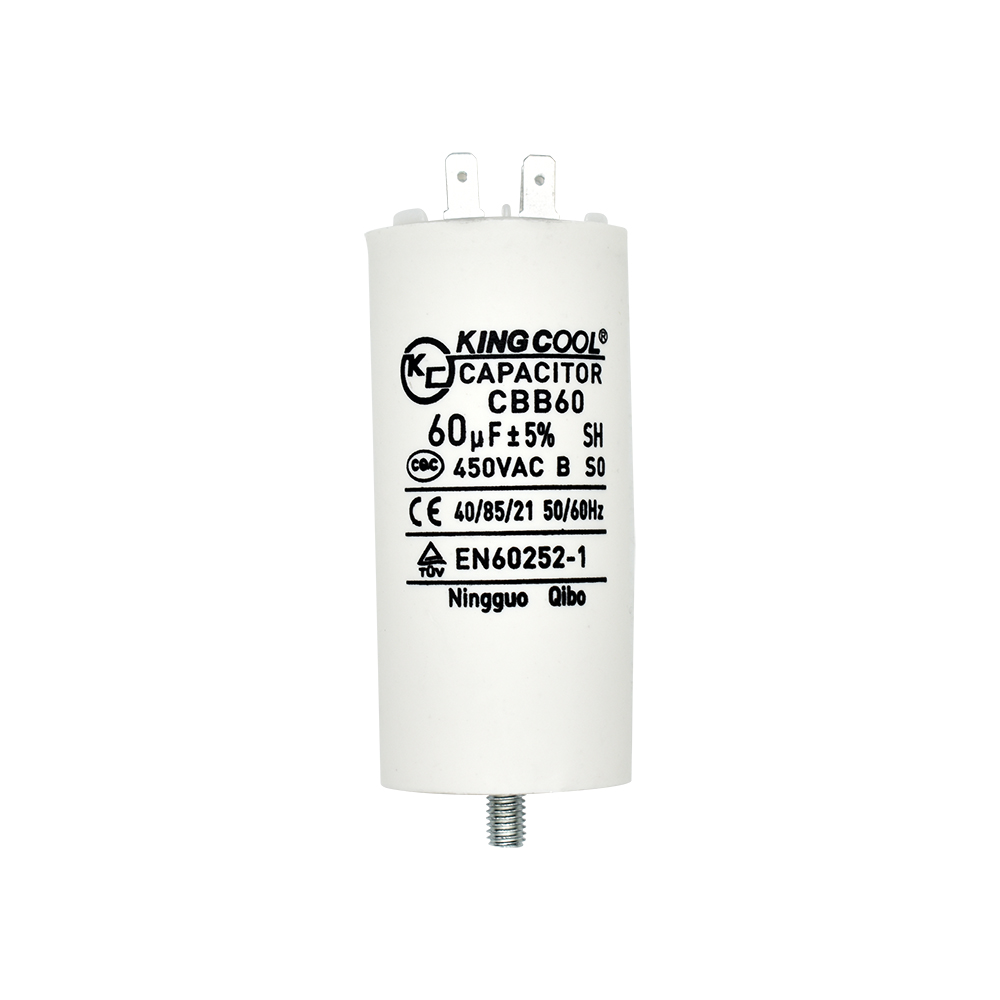 CBB60 Plastic-Case Water Pump Motor CapacitorPlastic-case metallized polypropylene capacitor for single-phase pump and appliance motors in moderate ambient conditions outside refrigeration.View Product →
CBB65 on compressor run duty in air conditioning and refrigeration
The aluminium-can series is specified where the capacitor sits beside a hot compressor shell and must hold capacitance through years of thermal cycling.
- Outdoor units of split air conditioners and heat pumps, usually 370 or 450 VAC in the 25 to 80 uF range
- Condensing units and commercial refrigeration packs, where condenser heat raises the compartment temperature further
- Compressor overload protection circuits that rely on stable phase shift under fluctuating supply voltage
Within the CBB65 family, the R1, R2 and R3 suffixes describe can length, terminal layout and mounting rather than a different electrical function, so a dimensional drawing matters more than the suffix alone. The practical differences are set out in this note on CBB65R versus CBB65 differences and installation.
Performance: Heat, Voltage Stress and Realistic Service Life
An oil-filled CBB65 tolerates a hotter compartment than an epoxy-sealed CBB60 of the same capacitance and voltage, because the filler moves heat from the film to the can instead of trapping it at the element.
Ambient class is the first performance number to read. Compressor-grade series are offered in 70 C and 85 C versions, and the 85 C version uses higher-grade film and a different impregnant. That matters in tropical installations: an air conditioner qualified to climate class T3 under IEC 60335-2-40 must operate at 52 C ambient, which pushes the capacitor hot spot far above what a 70 C plastic-case part is designed for.
Voltage stress follows the same logic. On a 230 VAC single-phase system the capacitor sees close to line voltage plus harmonic content, so 370 VAC is the usual minimum for 208 to 240 V equipment and 450 VAC is specified where supply swings are wide or the compressor is large.
Expected life follows the Arrhenius approximation used across film capacitor engineering: every 10 C reduction in hot-spot temperature roughly doubles expected life. That single relationship explains why an oil-filled can in the same circuit outlasts a plastic-case part, without any change in microfarads.
| Symptom | More likely on | What it indicates | Action |
| Capacitance loss, motor hums and will not start | CBB60 | Film degradation without pressure protection | Replace and inspect compartment temperature |
| Bulged can top, oil residue on the terminal block | CBB65 | Overpressure disconnector has opened | Replace, never reuse a bulged can |
| Shorted terminals, tripped fuse | Either type | Dielectric breakdown | Replace and check supply voltage |
| Slow capacitance drift within 5% | Either type | Normal ageing of the metallized film | Record the reading and monitor at next service |
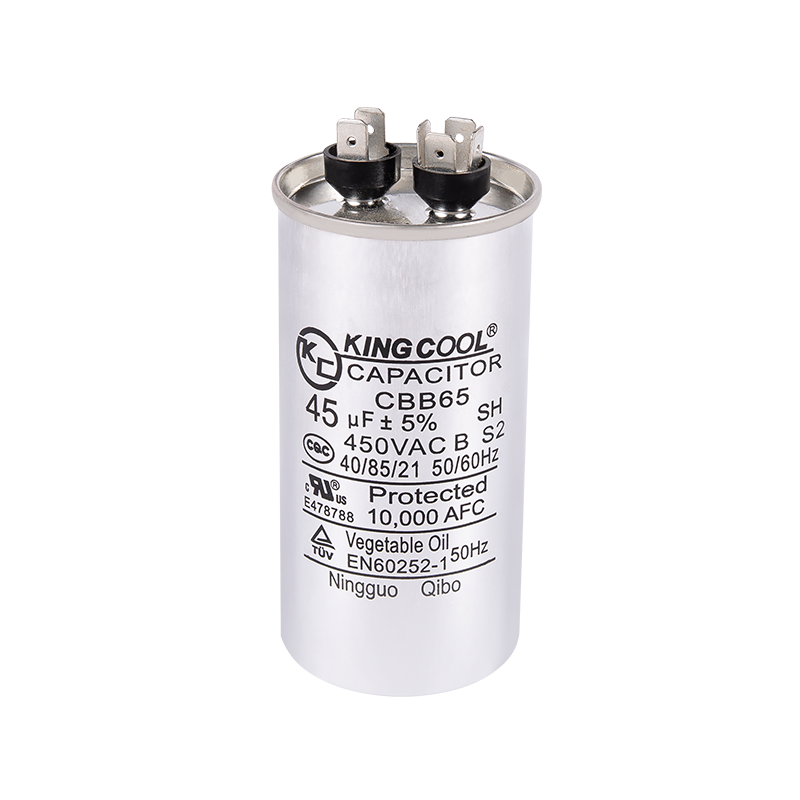 CBB65-R1 Oil-Filled Metal-Case Motor CapacitorOil-impregnated metal-case capacitor with internal pressure protection for single-phase air-conditioning, compressor and cold-dryer motor circuits.View Product →
Substitution Rules: When a CBB60 Can Stand In for a CBB65
A CBB60 may replace a CBB65 only when capacitance matches the original within 5%, the voltage rating is equal or higher, the ambient class covers the compartment, and the case fits both the clamp and the terminal spacing.
Match capacitance and tolerance A 35 uF compressor capacitor replaced with a 30 uF or 40 uF unit changes starting torque and running current. Stay inside the 5% band, which for a 35 uF part means 33.25 to 36.75 uF.
Match or exceed the voltage rating Moving from 370 VAC to 450 VAC is acceptable. Moving the other way is not, even when the capacitance and can size are identical.
Check the ambient class A 70 C part in an 85 C compressor compartment loses life from the first day of service, regardless of how well it fits.
Check physical fit before the van leaves Confirm can diameter and length, blade width of 4.8 mm or 6.3 mm, and strap diameter. Physical fit is where most substitutions fail in the field.
Record temporary repairs When only a plastic-case part is available for a compressor circuit, note it on the job sheet so the next service visit replaces it with the correct aluminium-can type.
Acceptable swap
- Same capacitance within 5%
- Equal or higher rated voltage
- Ambient class meets or beats the original
- Terminal spacing and strap match
- P2 protection retained or improved
Reject the swap
- Capacitance differs by more than 5%
- Voltage rating is lower than the original
- Plastic can placed against a hot compressor shell
- Blade width forces a loose or forced fit
- No declared safety class on the label
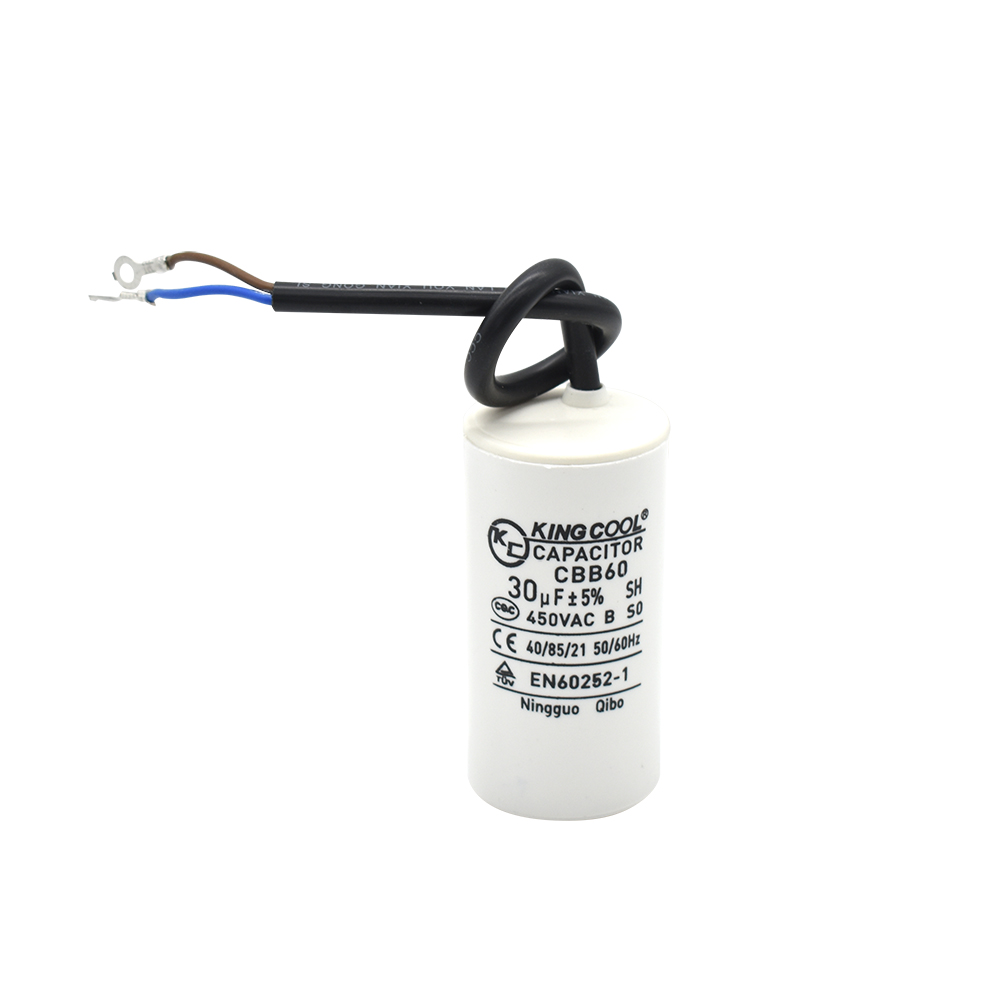 CBB60 Motor Running Capacitor for Single-Phase MotorsPlastic-case motor running capacitor for single-phase pump and appliance motors; verify test report, tolerance, filler declaration and dimensioned drawing before ordering.View Product →
Sourcing Checklist for Distributors and Repair Chains
Four documents decide whether a capacitor quotation is usable: an IEC 60252-1 test report, the capacitance tolerance stated at 20 C, a filler and case declaration for every rating, and a dimensioned drawing.
- Endurance test results at rated voltage, with the declared ambient class stated alongside them
- Capacitance measured at 20 C with the tolerance band written out, normally 5% and 10% for low-cost series
- Filler declaration for each rating, since epoxy, castor oil and wax sit at different price points
- Safety class declared as P0, P1 or P2, and whether the P2 version actually contains the disconnector
- Dimensional drawing for every capacitance in the quote, because two 35 uF CBB65 units from different factories rarely share the same can length
- Terminal type and blade width, whether two-blade, four-blade, screw or wire lead
Procurement note
Mixing safety classes inside a single shipment is the most common compliance gap in capacitor purchasing. A distributor who quotes P2 and ships P0 exposes every installer downstream to a silent failure mode, and the cost difference between the two is measured in cents per unit, not dollars.
The capacitor range used by most HVAC service buyers covers CBB60, CBB61, CBB65R1 to R3, CD60 start capacitors and CH85 microwave types, which makes it practical to standardise on one supplier while keeping the CBB65 specification separate from general motor duty.
Practical Answers on Fitting and Buying
Can a CBB65 replace a CBB60?
Yes, provided capacitance matches within 5% and the voltage rating is equal or higher. An aluminium-can CBB65 is physically larger and more expensive than the plastic part it replaces, but in an open, ventilated enclosure it delivers better heat rejection and a longer service life, so the substitution is an upgrade rather than a compromise.
Why does a CBB65 can bulge before it fails?
Bulging is the overpressure disconnector doing its job. As the metallized film degrades, internal pressure rises and the can top lifts to break the circuit. A bulged can that still reads correct capacitance on a meter should be replaced, because the disconnector has already been stressed and the element is past its design life.
What capacitance tolerance should a replacement carry?
Run capacitors are normally supplied with a 5% tolerance at 20 C under IEC 60252-1, so a 35 uF part should read between 33.25 and 36.75 uF. Anything outside that band will alter the phase angle between the main and auxiliary windings and change both starting torque and running current.
Does a higher voltage rating change motor performance?
No. A 450 VAC capacitor delivers the same capacitance and the same phase shift as a 370 VAC unit of identical rating; only the dielectric margin and the physical size change. The reason to buy the higher rating is supply voltage variation and dielectric stress, not motor behaviour.
Recommended NEWS:
CBB65-R1: Key Features and Applications of High-Performance AC Capacitors
CBB60 Capacitor: Comparison with CBB61 and SPP5 Capacitors
What is the Difference Between an AC Capacitor CBB65B and CBB65 in Motor Run Applications?
The Ultimate Guide to CBB60 450V AC Water Pump Capacitors: Usage, Replacement, and Troubleshooting
What Causes a CBB65 Run Capacitor to Bulge or Leak, and How Can You Identify Early Signs of Capacitance Loss?
Can a 450VAC Capacitor Replace a CBB65 Capacitor 250VAC 50 60Hz in Industrial Compressors?
Recommended Products
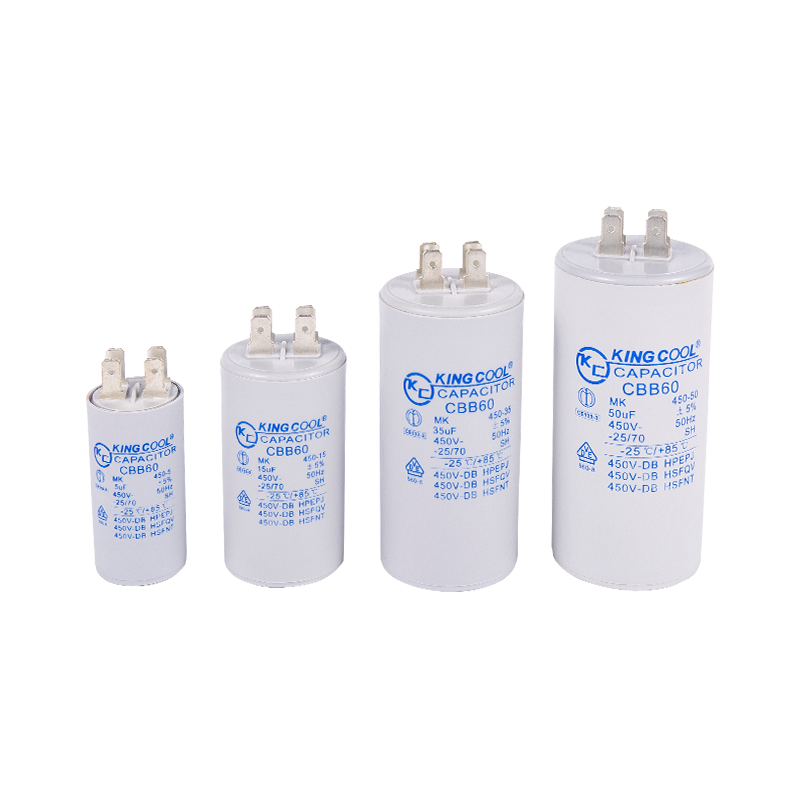

Efficient charging, stable output, capacitor, thefirst choice for electric drive.
- Address: North of Funing Rd., Helixi Economic and Technology Development Zone, Ningguo, Anhui, China
- Phone/WhatsApp: +86-18110862602
- Email: [email protected]
Subscribe Our Newsletter
If you have anything to consult, you canfollow us, we will contact you as soon aspossible

Copyright © Ningguo Kingcool Import and Export Co., Ltd All Rights Reserved. Custom HVAC Parts & Accessories Suppliers